Galapagos Islands Cruise Guide: Wildlife, Snorkelling, and the Best Routes to Sail
A Galapagos cruise puts you face-to-face with giant tortoises, marine iguanas, and blue-footed boobies on one of the planet's most extraordinary wildlife journeys.
Why a Galapagos Cruise Is Unlike Any Other Voyage
The Galapagos Islands sit roughly 1,000 kilometres off the coast of Ecuador in the Pacific Ocean, and they represent one of the most extraordinary wildlife destinations on earth. Charles Darwin's observations here in 1835 helped shape his theory of evolution, and the islands remain a living laboratory of natural selection. Animals that evolved in isolation from human predators show almost no fear of visitors, allowing encounters of breathtaking intimacy. A cruise is the ideal way to explore the archipelago, moving between islands overnight and waking each morning to a new landscape teeming with life.
Choosing Your Galapagos Cruise
The Galapagos archipelago consists of 13 major islands and dozens of smaller islets, spread across an area roughly the size of Belgium. No single cruise visits every island, so choosing the right itinerary is essential.
Western circuit cruises focus on Isabela and Fernandina, the youngest and most volcanically active islands. These are the best places to see flightless cormorants, Galapagos penguins, and vast colonies of marine iguanas. The snorkelling here is exceptional, with sea lions, sea turtles, and reef sharks as regular companions.
Eastern circuit cruises take in Santa Cruz, San Cristobal, and Espanola. Santa Cruz is home to the Charles Darwin Research Station, where you can see giant tortoises up close and learn about the conservation programmes that have brought several species back from the brink of extinction. Espanola is the best island for seeing waved albatrosses (present from April to December) and the famous blue-footed boobies performing their elaborate courtship dances.
Full circuit cruises of eight days or more combine both western and eastern highlights, offering the most comprehensive Galapagos experience. These longer voyages are ideal for serious wildlife enthusiasts and photographers.
Vessel sizes range from intimate eight-passenger yachts to larger expedition ships carrying 100 passengers. Smaller boats access more remote anchorages and offer a more personal experience, while larger vessels provide greater comfort and stability in rougher seas.
Wildlife Highlights by Island
Santa Cruz
The most visited island in the archipelago, Santa Cruz offers the Charles Darwin Research Station, giant tortoise breeding centres, and the extraordinary lava tube tunnels that run beneath the island's surface. The highlands are home to wild giant tortoises roaming freely through misty cloud forest, an unforgettable sight.
Fernandina
The youngest and most pristine island in the Galapagos, Fernandina has never been colonised by introduced species. Marine iguanas pile on top of each other in vast, prehistoric-looking heaps along the shoreline, while flightless cormorants dry their vestigial wings in the sun. The snorkelling off Punta Espinoza is among the best in the archipelago.
Espanola
The oldest island in the chain, Espanola is famous for its seabird colonies. Waved albatrosses perform their extraordinary bill-clacking courtship rituals here, and Nazca boobies nest in large numbers. The blowhole at Suarez Point sends jets of water skyward with each wave, creating a dramatic natural spectacle.
Genovesa
Known as Bird Island, Genovesa is a collapsed volcanic caldera that shelters one of the largest red-footed booby colonies in the world. Short-eared owls hunt storm petrels in broad daylight, and the snorkelling in Darwin Bay reveals hammerhead sharks and eagle rays.
Use our [currency converter](/currency) to plan your budget, as Galapagos cruises vary widely in price depending on vessel class and itinerary length.
Snorkelling and Diving in the Galapagos
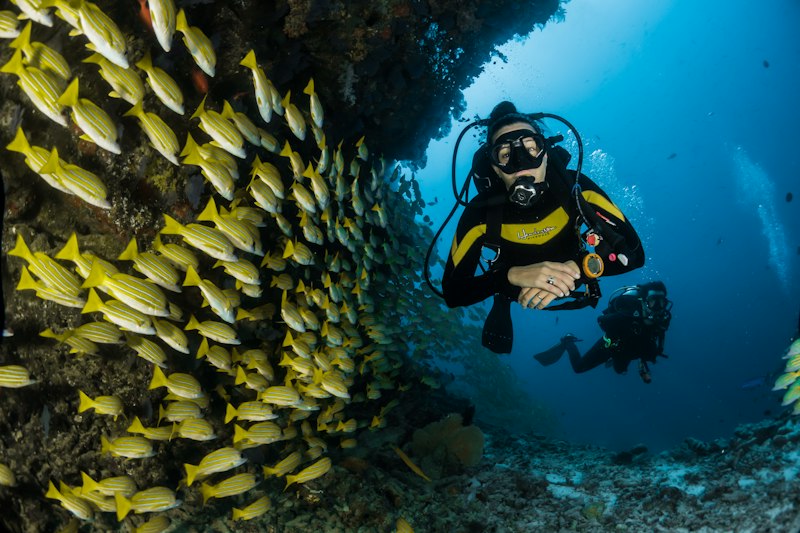
The waters surrounding the Galapagos are among the richest in the world, fed by cold upwellings from the Humboldt and Cromwell currents. Even snorkellers encounter an astonishing array of marine life: Galapagos sea lions play around you in the shallows, green sea turtles glide past with unhurried grace, and white-tipped reef sharks rest on sandy bottoms beneath overhanging rocks.
Scuba divers can access some of the world's most thrilling dive sites. Gordon Rocks near Santa Cruz is famous for schooling hammerhead sharks, while Wolf and Darwin Islands in the far north offer encounters with whale sharks, the largest fish in the ocean. These remote northern sites are accessible only on liveaboard dive cruises.
Water temperatures vary significantly by season. The warm season (December to May) brings calmer seas and water temperatures of 22-27°C, ideal for snorkelling. The cool season (June to November) brings colder water (18-22°C) but exceptional visibility and the best wildlife activity, including albatross courtship and penguin breeding.
Practical Tips for Your Galapagos Cruise
Check live weather on our [city dashboard](/) for current conditions in the Galapagos before your departure.
Conservation and Responsible Tourism
The Galapagos National Park covers 97% of the archipelago's land area, and strict regulations protect the islands' fragile ecosystems. Visitors must stay on marked trails, maintain a two-metre distance from wildlife (though the animals themselves often ignore this rule), and never feed or touch any creature. These rules exist not to restrict your experience but to preserve it for future generations.
The park authority limits the number of visitors to each site and rotates access to allow ecosystems to recover. By choosing a reputable cruise operator that adheres to these regulations, you contribute directly to the conservation of one of the world's most irreplaceable natural treasures.
Browse more articles on our [blog](/blog) for more cruise guides and wildlife travel inspiration from around the globe.